Showing posts with label sensual stories. Show all posts

Sunday, January 22, 2012

On the flesh of language


Started reading a book the other day, "The Spell of the Sensuous" by David Abram. It's a nonfiction, rather scholarly book, coming under the subject heading of "nature/philosophy." I was looking for a book in relation to human spirit and the natural environment.

In the chapter I'm reading this morning, "The Flesh of Language," I found this passage particularly noteworthy, and wanted to share it.

"We thus learn our native language not mentally but bodily. We appropriate new words and phrases first through their expressive tonality and texture, through the way they feel in the mouth or roll off the tongue, and it is this direct, felt significance--the taste of a word or phrase, the way it influences or modulates the body--that provides the fertile, polyvalent source for all the more refined and rarefied meanings which that term may come to have for us."

I love words and how they work together and how evocative they can be. The sensations that can erupt from the use of a single word, or a phrase woven together.

Language at its core can be a primal thing. When an infant utters that first cry when he or she emerges into the world, this is not a learned response. It is a response to a bodily event. It comes from within, not without, yet it is a response to exit from that safe, warm environment of a mother's womb, into a larger, unknown environment. For that small individual, the utterance of that first cry represents many things, none of them actually learned. It is instinct at its most basic level. A reaction to altered bodily state and the spark of recognition to that state.

A cry--pain, happiness, despair, joy, anger, surprise, ecstasy. That sound--the word "cry" is so much more--that bit of language is represented differently for each emotion, each sensation, each experience.

"He cried out," informs us little of the experience. "He shouted for joy." "She sobbed," "He groaned," "The drawn out unearthly howl echoed through the moonless black night." "His bitter words scorched her with the fury of his anger."

Words are not simply words. Nor is a phrase or sentence just a bunch of words to trip the story along. Nor should they be a mimic of some other story that one thinks fits the scene. Language has to be real to these characters in this story, in this moment. Time, space, moment, era, world, instinct, sensation. Shy, bold, brash, demure, aggressive, dominant, submissive, sophisticated, extrovert, introvert, slave, master, powerful, sly, coarse, smooth, Caucasian, Hispanic, African-American, Native American, Black, White, Asian, man, woman, child, infant, ghost, shapeshifter, wolf, bird, fish, merman...Quentopian, Orictan... or any combination. How will the cry differ? I want to feel the words in my bones. I want to taste its color. Let me experience the words deep into my soul. I want them to grip to squeeze, my heart and mind.

Monday, June 2, 2008

A Discussion of Demons


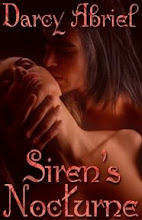
Ah, evening is upon me and day is dwindling away. This then is my virgin post. I learned some very interesting things as I was researching the subject of demons for my story Siren's Nocturne. Well, actually, I believe it was the other way around. I was researching demons which breathed life into Siren's Nocturne. Much fodder for many stories.

Demons--presently associated with evil, but before Christianity and in other cultures, demons were in the past and currently are, neither necessarily good or evil. There are a wide range of demons, both good and bad--just as there are humans.

Penetrating deeper into my subject,the word demon means "replete with wisdom." The Greek term daimon means "divine power," "fate," or "god."

A male demon is called an incubus, and incubi are certainly notorious for being extremely well hung. Probably part of the reason they are such delicious fodder for erotic stories. And then there's the dark, mysteriously passionate adventure, piercing into the seductive unknown that titillates many people, I think.

There are also many legends through history about fallen angels, particularly those known as the Grigori. Interpretation lends itself to the belief that some of these fallen angels are beings who have become distanced the farthest from God. Angels who became watchers--considered by some as a separate tribe of angels--and in human form very corruptible to the sins of the flesh--a lusty tenth choir of angels. This tenth choir, more human in form than not because of their close proximity to earth, and "physically intact," unlike many of their kind, are more than able to succumb to the seductive lure of tantalizing flesh.

And let's not forget the "Harlots of Hell" or Succubae--the female demons. More particularly, the first bride of Hell--the lethal, mysterious, and seductive Lilith, thought to have gone by many names in order to seduce her victims. Men did run for the hills when the name of Lilith and her followers was invoked.

In one sense these beings are considered to be a type of god with their divine powers. Another interpretation is that demons are intermediaries between men and gods, maybe a form of demi-god.

In the first hierarchy of demons resides the demon, Asmodeus, considered one of the demons of lust, some say of impurity. His association with lust may stem from the belief that he is a child born of the Hell-queen herself, Lilith. A Persian demon, he is also believed to be the demon in control of gaming houses.

In the second hierarchy of demons resides the demon Rosier, formerly believed to be a lesser-ranked angel, a demon of lasciviousness.

Friar Francesco Mario Buazzo, in the early 1600's divided demons into types: fire demons, aerial demons, terrestrial demons, aqueous demons, subterranean demons, heliophobic (only coming at night) demons. Possibly the heliophobic demons relate to the association with vampires.

Alphonse de Spina notes that there are ten species of demons, among them incubi and succubi, who stimulate lust and perversion.

Then there is the text at Project Gutenberg on Elizabethan Demonology which is an essay by Thomas Alfred Spalding, LL.B. (1880) that appears to indicate a very close association between fairies and demons and the powers they both possess.

So, as we see, it can be a very complicated subject, with varying interpretations on the subject of demonology and angelology.

In Siren's Nocturne, you will need to decide for yourself--Is Etienne good or is he bad?Or is he just a seductive demon trying to live his life? And find his mate. Will Lucille made the right choice in the end? And then one might consider, is it the right choice for you? Or for her?

wishing you passionate nocturnal whisperings,

Darcy

Additional sources:

A Dictionary of Angels Including the Fallen Angels by Gustav Davidson (c. 1967)
Angels, An Endangered Species by Malcolm Godwin (c. 1990)
The Encyclopedia of Witches and Witchcraft by Rosemary Ellen Guiley (c.1989)